If you've been paying attention to the news lately, you know that inflation is going up. Inflation is at its highest level in 40 years. The National Association of Home Builders (NAHB) says the following:
"Consumer prices went up again in May, as prices for housing, energy, and food kept going up at the fastest rate in decades. This was the first time since December 1981 that the rate of inflation was higher than 8% for three months in a row.
As prices go up for gas, groceries, and other things, you may be able to tell that inflation is going up. The rising cost of goods and services can put a strain on your budget and make you think twice about any big purchases you were planning.
If you've been thinking about buying a home this year, you might be wondering if you should go ahead or if it would be better to wait. The answer depends on your situation, but here are some ways that being a homeowner can help you deal with the rising costs caused by inflation.
Buying a home helps you keep one of your biggest monthly costs stable.
Investopedia says that when there is a lot of inflation, prices go up everywhere. This is true for food, entertainment, and many other goods and services, including housing. Prices for both homes and apartments are going up. So, how can you, as a buyer, protect yourself from rising prices? The answer is to buy a house.
When you buy a home, you can stabilize what is usually your biggest monthly cost: housing. With a fixed-rate mortgage, your monthly payment stays the same for the life of the loan, which is usually between 15 and 30 years. Senior Wealth Management Reporter at Bankrate, James Royal, says:
"A fixed-rate mortgage lets you keep most of your housing costs at the same payment amount. Even though your property taxes will go up and you may have to pay more for other things, your monthly housing payment will stay the same. If you rent, that's certainly not the case."
So, even if the prices of other things go up, your rent will stay the same, which will help you keep your budget in order. If you rent, you don't have that benefit, and you won't be protected from rising housing costs.
Putting money into something that has historically done better than inflation
While it’s true rising home prices and higher mortgage rates mean that buying a house today costs more than it did even a few months ago, you still have an opportunity to set yourself up for a long-term win. When inflation is high, you want your money to be invested in something that does better than inflation and usually holds or grows in value.
The graph below shows how the average home price appreciation outperformed the average inflation rate in most decades going all the way back to the seventies – making homeownership a historically strong hedge against inflation (see graph below):
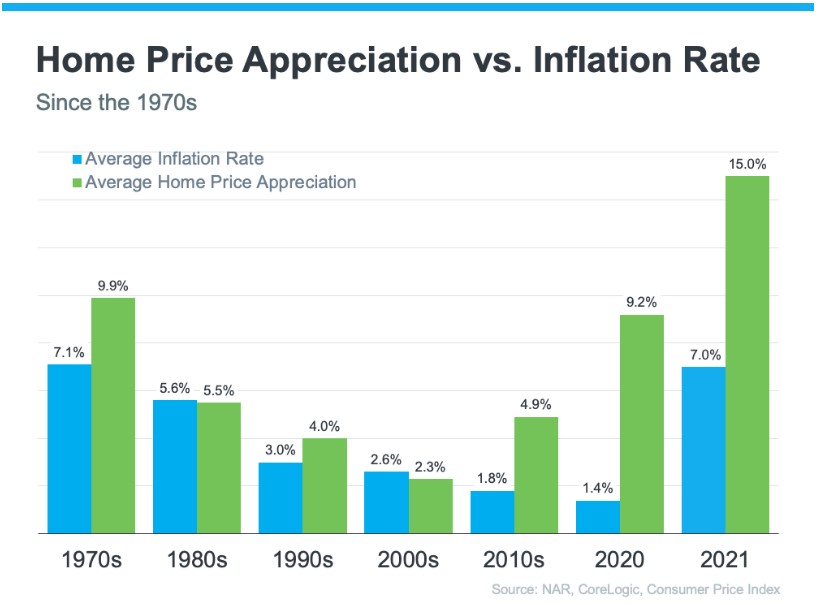
So, how does that affect you? Experts think that home prices will only go up from here on out because supply and demand are still not in balance. If the price of your home goes up after you buy it, your equity and your net worth will grow. And because homes are usually assets that increase in value over time, you can be sure that your investment is a good one.
That means that if you are ready and able, you should buy now before prices go up even more.
Bottom Line
Even though prices are going up, if you want to buy a house this year, it makes sense to do it soon. So, you can keep your monthly housing costs stable and put your money into an asset that has historically done better than inflation. If you're ready to get started, let's talk so that when you're ready to buy a home, you can get expert advice on your specific situation.


